Reverse Snow Angel Exercise
A floor-based upper back exercise that sweeps your arms through a full range of motion while face down — one of the most effective posture-correction movements you can do without equipment.
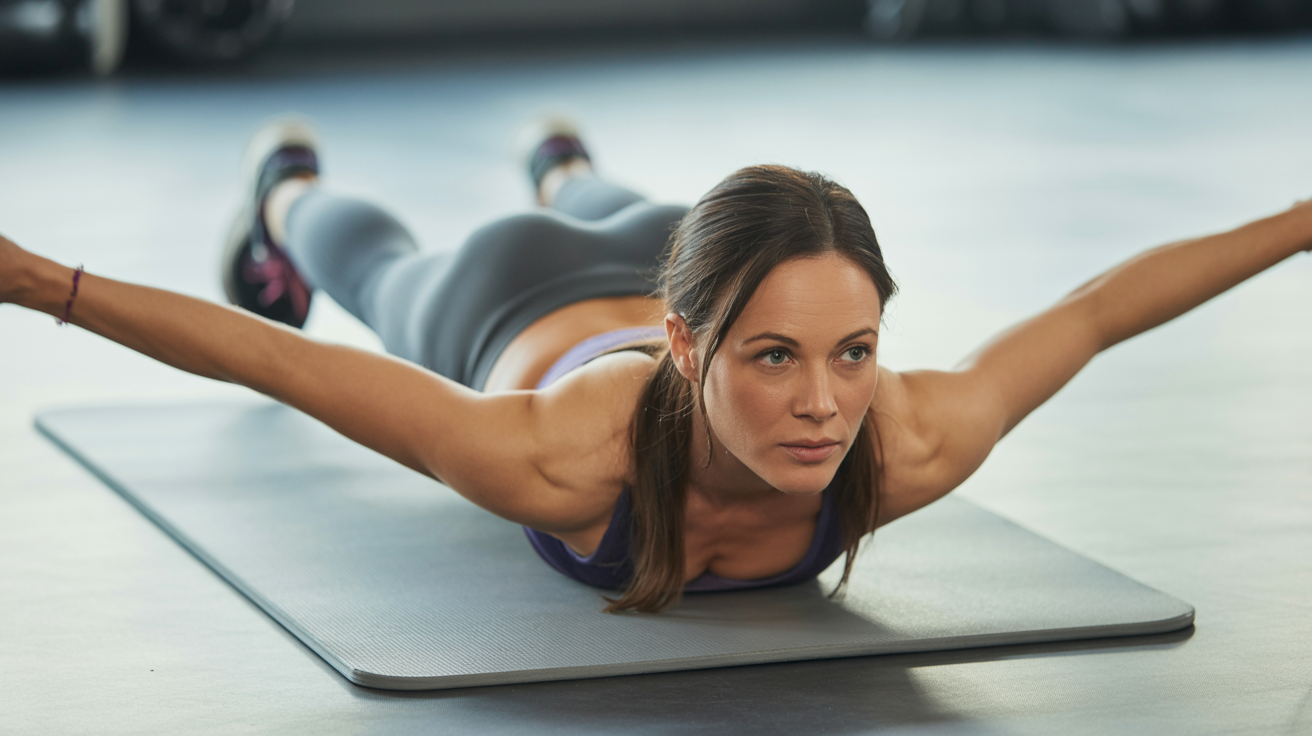
How to Do It
- 1Lie face down with arms at your sides, palms up
- 2Engage core and lift chest slightly off floor
- 3Keep chest lifted throughout the movement
- 4Slowly sweep arms along the floor toward overhead
- 5Rotate palms as you go (palms down when overhead)
- 6Sweep arms back down to start, rotating palms up
- 7Maintain lifted chest throughout the entire motion
- 8Move slowly and with control
How Many Calories Does the Reverse Snow Angel Burn?
The reverse snow angel is a low-intensity exercise — calorie burn is modest but real, especially when done as part of a longer mobility routine. Use our free Calories Burned Calculator to see exactly how much you burn based on your weight and duration.
Calculate Your Calories Burned →Common Mistakes to Avoid
Make It Easier
- Smaller range of motion
- Pause at each position (Y, T, I)
- Chest on floor
Make It Harder
- Hold at each position for 2-3 seconds
- Add small weights
- Increase tempo
Why the Reverse Snow Angel Is One of the Best Posture Exercises
Most upper back exercises require a gym, a cable machine, or at minimum a resistance band. The reverse snow angel needs nothing. You lie face down, you move your arms, and you directly target the muscles that desk work, driving, and screen time systematically weaken — the rhomboids, rear deltoids, and mid-traps that pull your shoulders back and hold your spine upright. When these muscles weaken, your shoulders round forward, your head drifts in front of your spine, and the chain of compensations that leads to neck pain, upper back tension, and shoulder impingement begins. The reverse snow angel interrupts that chain. It is simple, quiet, takes two minutes, and can be done in your living room between meetings. That combination is why physical therapists recommend it so frequently and why it belongs in almost every adult's daily routine.
Why This Exercise Matters More After 40
Postural muscles weaken gradually — the damage from years of sitting accumulates slowly enough that most people don't notice until their 40s when the consequences become impossible to ignore. By this point the rhomboids and rear deltoids are often significantly undertrained relative to the chest and front shoulders, creating a muscular imbalance that pulls the entire upper body forward. This imbalance is harder to reverse after 40 than it is to prevent — which makes consistent posterior chain work like the reverse snow angel one of the highest-return investments an adult over 40 can make in their physical health. That said, the benefits are not exclusive to older adults. Anyone who sits more than six hours a day — at any age — is dealing with the same muscular imbalance and will benefit from this exercise equally.
Frequently Asked Questions
What muscles does the reverse snow angel work?
The reverse snow angel primarily targets the upper back muscles — specifically the rhomboids, rear deltoids, and mid and lower trapezius. Secondary muscles engaged include the erector spinae along the lower back and the rotator cuff stabilizers. It is one of the few bodyweight exercises that directly trains the posterior shoulder and mid-back simultaneously without any equipment.
How do you do a reverse snow angel properly?
Lie face down with arms at your sides, palms facing up. Engage your core and lift your chest slightly off the floor — maintain this lift throughout the entire movement. Slowly sweep your arms along the floor in an arc from your hips toward overhead, rotating your palms to face down as your arms reach the overhead position. Pause briefly, then reverse the motion back to the starting position. Move slowly and with control throughout. The chest lift should remain consistent — do not drop it as your arms move overhead.
Is the reverse snow angel good for posture?
Yes — it is one of the most effective bodyweight exercises for posture correction specifically because it targets the muscles that desk work weakens most directly. The rhomboids and mid-traps are responsible for retracting and depressing the shoulder blades, pulling them back and down into correct alignment. Strengthening these muscles directly counteracts the forward shoulder rounding and upper back hunch that develops from prolonged sitting. For noticeable posture improvement, perform 2–3 sets of 10–15 reps daily for 4–6 weeks.
What is the difference between a snow angel and a reverse snow angel?
A regular snow angel is performed lying on your back, moving both arms and legs outward simultaneously. The reverse snow angel is performed lying face down, moving only the arms while maintaining a slight chest lift. The reverse version targets the posterior chain — the muscles along the back of the body — while a regular snow angel primarily stretches the chest and hip flexors. For posture correction and upper back strengthening the reverse version is significantly more effective.
How many reverse snow angels should I do?
Start with 2 sets of 10 repetitions, focusing on controlled movement and maintaining the chest lift throughout. Progress to 3 sets of 15 repetitions over 2–3 weeks. For desk workers, performing a quick set every few hours throughout the workday is an effective strategy for combating postural fatigue — the exercise is quiet, requires no equipment, and takes under two minutes per set.
Can I do reverse snow angels with lower back pain?
Generally yes — the reverse snow angel strengthens the lower back muscles which can help reduce chronic lower back pain over time. However if the prone position itself aggravates your back, start with a very minimal chest lift or keep your chest flat on the floor entirely and focus only on the arm sweep. If you experience sharp or radiating pain, stop immediately and consult a healthcare professional before continuing.
Can I do reverse snow angels every day?
Yes. Because this is a low-intensity mobility and activation exercise rather than a high-load strength movement, daily practice is appropriate and beneficial for most people. Unlike heavy compound lifts that require recovery time, the reverse snow angel can be performed daily as part of a morning routine, between work sessions, or as an evening recovery practice.
Quick Stats
Perfect For
Related Exercises
Helpful Fitness Tools
Plan your training and nutrition for better results: