Decline Push-Up
An elevated push-up variation with feet higher than hands — shifts greater load to the upper chest and anterior shoulders compared to a standard push-up for a more complete pushing pattern.
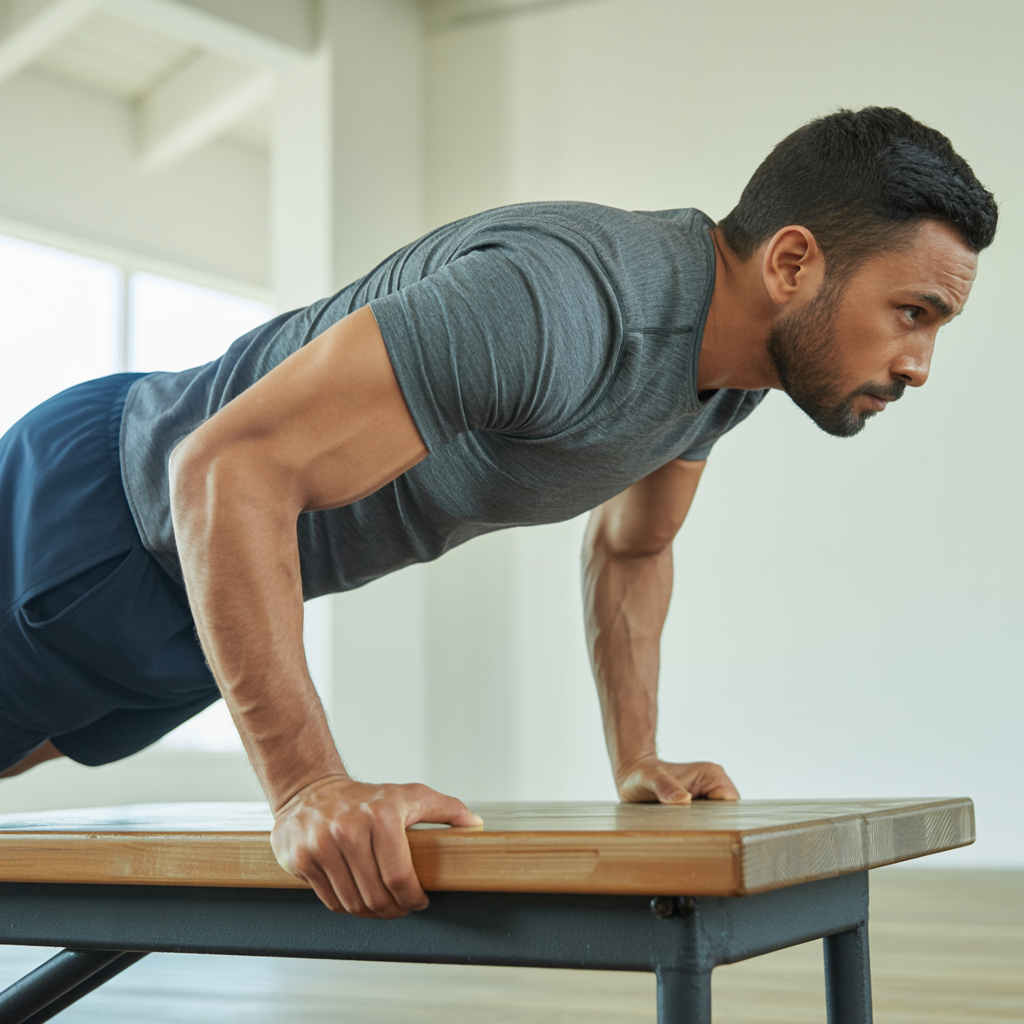
How to Do It
- 1Place feet on a chair, couch, or stairs
- 2Hands on floor slightly wider than shoulders
- 3Body forms a declining straight line
- 4Engage core and glutes to maintain position
- 5Lower chest toward floor
- 6Keep elbows at 45-degree angle
- 7Go until chest nearly touches floor
- 8Push back up with control
How Many Calories Do Decline Push-Ups Burn?
Push-up variations burn more calories than most people expect, particularly when performed in circuits or with minimal rest. Use our free Calories Burned Calculator to find your exact number based on your weight and workout duration.
Calculate Your Calories Burned →Common Mistakes to Avoid
Make It Easier
- Lower elevation (use one stair)
- Standard push-up
- Knee decline push-up
Make It Harder
- Higher elevation
- Pause at bottom
- Diamond decline push-up
Why the Decline Push-Up Is Worth Adding to Your Routine
The standard push-up is one of the most effective bodyweight exercises ever designed — but it has a limitation. By training the chest at a neutral angle, it primarily develops the mid and lower chest while leaving the upper chest and anterior shoulder relatively understimulated. The decline push-up addresses this by elevating the feet, changing the angle of the movement and shifting greater load to the upper chest compared to a standard push-up — research consistently supports increased upper pectoral activation at the declined angle. The result is a more complete chest training stimulus using nothing but your own bodyweight and a chair. For anyone training at home without a bench press or cable machine, the decline push-up is the closest equivalent to an incline press you can perform without equipment. It builds upper chest development, strengthens the front of the shoulder for pressing and pushing movements, and develops the triceps as a secondary mover throughout the range of motion.
Decline Push-Ups After 40 — What to Know
The decline push-up is an excellent exercise after 40 with one important consideration: wrist and shoulder health. As joint mobility and connective tissue resilience change with age, the increased load on the wrists from the declined position can aggravate existing wrist sensitivity more than a standard push-up. If you notice wrist discomfort, use push-up handles or place your hands on dumbbells to reduce wrist extension. For shoulder impingement or rotator cuff sensitivity, reduce the elevation height — a lower foot position decreases the shoulder angle and reduces anterior shoulder strain significantly. Research suggests avoiding elevations beyond 60 degrees as this shifts focus away from the chest and increases anterior deltoid strain. The core demand of the decline position is notably higher than a standard push-up, which is a benefit for adults over 40 working to maintain core stability and spinal integrity. Start with a lower elevation, master the form, and progress height gradually.
Frequently Asked Questions
What muscles do decline push-ups work?
Decline push-ups primarily target the upper chest — specifically the clavicular head of the pectoralis major — and the anterior deltoids at the front of the shoulders. Secondary muscles include the triceps, which assist with elbow extension throughout the pushing movement, and the entire core musculature which works isometrically to maintain a rigid body position. The serratus anterior — an often undertrained muscle along the side of the ribcage — is also engaged as a stabilizer, and weakness here often leads to poor pressing performance or rotator cuff issues over time.
What is the difference between incline and decline push-ups?
Incline push-ups have your hands elevated and feet on the floor — this reduces the load and is a beginner-friendly variation. Decline push-ups have your feet elevated and hands on the floor — this increases the load and shifts greater emphasis to the upper chest and shoulders, making it a more advanced variation. Think of incline as easier and lower-chest focused, decline as harder and upper-chest focused.
How high should my feet be for decline push-ups?
Start with a low elevation — one step of a staircase or a thick book is appropriate for beginners. A standard chair seat at approximately 17–18 inches is the most common elevation for intermediate practitioners. Research suggests avoiding elevations beyond 60 degrees as this shifts focus away from the upper chest and toward the anterior deltoid. Beginners should master form at low elevation before progressing higher.
Are decline push-ups bad for your shoulders?
Decline push-ups are generally safe for healthy shoulders when performed with correct form — elbows at approximately 45 degrees from the torso rather than flaring wide, and consistent core engagement to prevent hip sag. For individuals with existing shoulder impingement or rotator cuff issues, the declined position can increase anterior shoulder compression. In these cases reduce the elevation height, slow down the movement, and focus on not letting the shoulders shrug upward during the press.
How many decline push-ups should I do?
For strength development aim for 3–4 sets of 6–12 repetitions with controlled tempo — 2 seconds down, brief pause, 1 second up. For muscular endurance perform 2–3 sets of 15–20 repetitions with shorter rest periods. If you cannot complete 5 decline push-ups with good form, reduce the elevation and build strength at a lower angle before progressing.
Can beginners do decline push-ups?
Decline push-ups are classified as an intermediate exercise and are not ideal as a starting point for true beginners. If you cannot comfortably perform 15 standard push-ups with proper form, build that foundation first. The correct progression is: incline push-up → standard push-up → decline push-up. This ensures you have the shoulder stability, core strength, and wrist conditioning required before adding the increased demands of the declined position.
Quick Stats
Perfect For
Related Exercises
Helpful Fitness Tools
Plan your training and nutrition for better results: